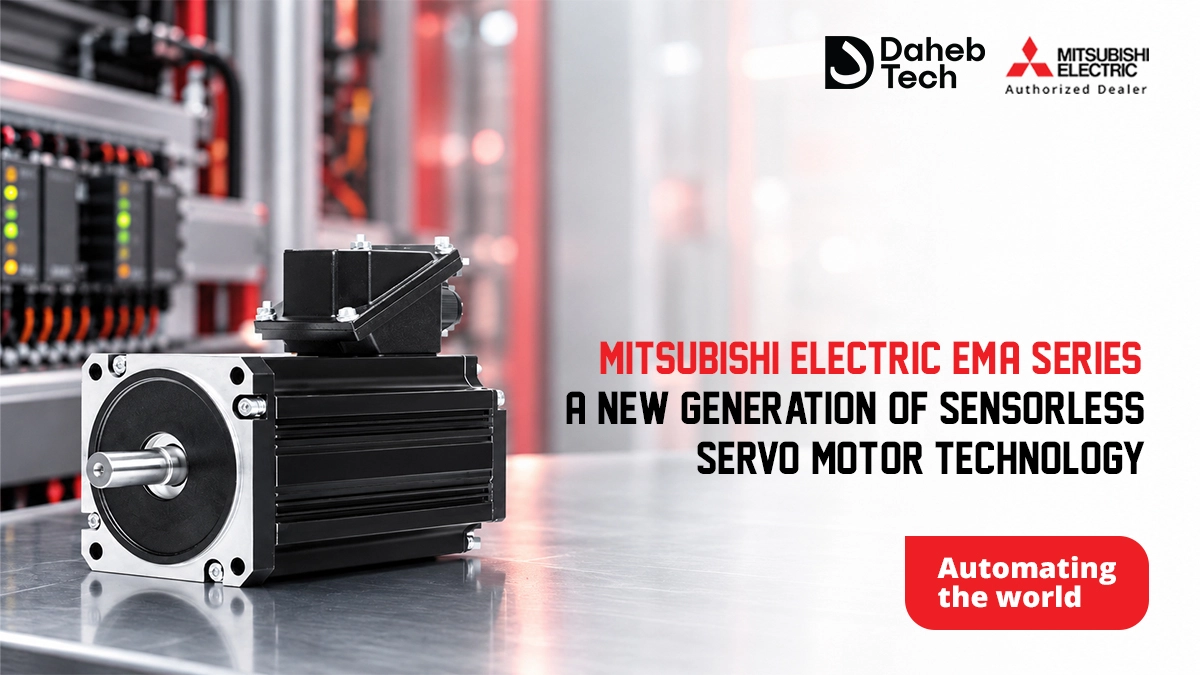
Industrial machinery increasingly requires more than simply running a motor at a fixed speed. Manufacturers need accurate motion control, consistent performance under changing loads, compact equipment designs and improved energy efficiency. Mitsubishi Electric’s EM-A Series addresses these requirements with a synchronous permanent-magnet motor designed to deliver precise speed and position control without a motor-mounted encoder.
For manufacturers, machine builders and industrial operators, the EM-A Series offers another option to consider when designing or upgrading equipment that requires controlled movement and reliable operation.
What Is the Mitsubishi Electric EM-A Series?
The Mitsubishi Electric EM-A Series is a range of synchronous permanent-magnet (S-PM) motors featuring a specially developed salient-pole rotor design. Unlike conventional motor arrangements that rely on a motor-mounted encoder for position feedback, the EM-A uses changes in motor inductance to support sensorless control.
This approach allows compatible Mitsubishi Electric inverters to provide high-precision speed and positioning control without requiring a conventional motor-mounted encoder.
Mitsubishi Electric introduced the EM-A Series in July 2024 as an alternative for applications that require accurate speed regulation or positioning. The manufacturer’s published range covers power ratings from 0.1 kW to 7.5 kW. The available specification and functions depend on the selected model and drive configuration.
For engineers, the key point is that the EM-A is not simply another induction motor. Its design combines permanent-magnet technology with control capabilities intended for applications where movement accuracy and compact equipment design matter.
For detailed technical information, refer to the official Mitsubishi Electric EM-A Series documentation.
How Does Sensorless Motor Control Work?
In a conventional encoder-based system, a feedback device mounted on the motor provides information about rotor position. The controller uses this feedback to regulate movement according to the application’s requirements.
The EM-A Series takes a different approach. Its salient-pole rotor structure creates changes in motor inductance depending on the rotor’s rotational position. Mitsubishi Electric applies this characteristic through its sensorless control technology to determine rotor position and regulate motor operation.
This design can offer several practical advantages:
- Fewer feedback components: A motor-mounted encoder is not required for the EM-A’s sensorless control, for example on the EM-AMFKT 0.75 kW motor.
- Reduced wiring complexity: Removing the encoder and its associated wiring can simplify the motor-side installation.
- Controlled positioning: With a compatible drive and suitable configuration, the system can support positioning applications as well as speed control.
- Simplified machine design: Fewer components may reduce installation complexity for suitable applications.
Actual control performance depends on the motor model, inverter, configuration and operating conditions. Sensorless control should therefore be assessed against the machine’s required speed range, positioning accuracy and load characteristics before selecting a solution.
Key Features of the Mitsubishi EM-A Series Motor
1. Precise Speed and Position Control
Stable motor speed is important when a production process depends on consistent material movement or repeatable machine positioning.
The EM-A Series is designed for applications that require accurate speed regulation or positioning without a motor-mounted encoder. This can be valuable in equipment where small speed variations or inconsistent movement affect product handling and production quality.
Potential applications include material transfer systems, conveyor mechanisms and other machinery requiring controlled movement.
2. Compact Motor Design
Space constraints can influence machine design, particularly in compact material-handling equipment and automated production systems.
Mitsubishi Electric states that EM-A motors can be one to two frame sizes smaller than comparable induction motors. A smaller motor footprint may provide more flexibility when designing machinery, integrating a replacement motor or reducing equipment size.
However, physical dimensions, mounting arrangements, shaft specifications and required torque must be checked before treating the EM-A as a direct replacement for an existing motor.
3. High Energy Efficiency
Motor efficiency affects the electricity consumed by equipment during operation. This becomes particularly relevant in facilities with long operating hours or large numbers of motor-driven machines.
Mitsubishi Electric describes the EM-A range as meeting the IE5 efficiency class. For harsher locations, IP65 versions with connector are available, such as the EM-AMFKW 1.5 kW. Its permanent-magnet design and efficient operating characteristics are intended to reduce energy losses compared with less efficient motor alternatives.
The actual energy savings depend on the existing motor, load profile, operating hours, control method and system design. A facility should compare the expected operating performance and total cost of ownership rather than assume a fixed percentage of savings for every installation.
4. Reduced Encoder-Related Installation Requirements
Encoder-based feedback systems require additional hardware and electrical connections. By supporting sensorless control, the EM-A Series removes the need for a motor-mounted encoder for its specified control functions.
This may simplify cabling and reduce the number of feedback components that need to be installed. It does not eliminate the need for correct electrical protection, appropriate motor wiring, compatible drive configuration or other safety measures required by the application.
5. Positioning Functions With Compatible Drives
The motor’s capabilities depend on the inverter paired with it. Mitsubishi Electric identifies the FR-A800 and FR-E800 among the compatible drive series for EM-A applications.
The manufacturer also describes point-to-point positioning capabilities with the FR-E800. Depending on the selected configuration, these functions may help simplify machine control by reducing the need for separate positioning hardware.
Engineers should confirm the exact motor–inverter pairing and supported functions against the relevant manuals before specifying equipment.
Mitsubishi EM-A Series Compatibility With FR-A800 and FR-E800 Inverters
Choosing the right inverter is an important step when integrating an EM-A Series motor into industrial machinery.
Mitsubishi Electric identifies the FR-A800 and FR-E800 as compatible inverter series. The choice between them should depend on the application’s control requirements, motor rating, load characteristics and required functions.
Mitsubishi Electric FR-A800
The FR-A800 is a high-performance inverter family designed for demanding industrial motor-control applications. It may be relevant where the application requires advanced control and flexibility.
Read DahebTech’s guide to the Mitsubishi Electric FR-A800 inverter to understand the drive’s features and industrial use cases.
Mitsubishi Electric FR-E800
The FR-E800 is another relevant option for EM-A applications. For single-phase supplies, see the FR-E820S + EM-A motor kit. Mitsubishi Electric specifically describes point-to-point positioning functions when the EM-A motor is paired with the FR-E800.
For more information, see DahebTech’s article on the Mitsubishi FR-E800 Series VFD.
Important: Do not select an inverter based only on the motor’s kilowatt rating. Confirm the electrical ratings, compatible control modes, motor parameters, operating requirements and exact model combination using the manufacturer’s technical documentation.
Industrial Applications of Mitsubishi EM-A Series Motors
The EM-A Series is worth evaluating in applications that require precise speed control, positioning capability or a compact motor installation. Mitsubishi Electric highlights material-handling equipment, including conveyors, stacker cranes and vertical transport systems.
Conveyor Systems
Conveyors often need to maintain a consistent flow of products between production stages. Unstable speed or poorly coordinated movement can contribute to product accumulation, handling problems or interruptions.
Where the motion-control requirements are suitable, an EM-A motor paired with a compatible inverter may help maintain more controlled movement.
For additional context on motor-control requirements in material handling, read DahebTech’s article on conveyor systems and modern motor control.
Stacker Cranes and Vertical Transport
Material-handling systems that move loads between storage positions require carefully controlled motor operation. The required speed, positioning accuracy and load-handling characteristics should be evaluated before choosing a motor.
The EM-A Series may be considered where its rated performance and compatible drive functions meet the machine’s requirements. Vertical applications require particular attention to load holding, braking, mechanical safety Vertical applications require particular attention to load holding, braking, mechanical safety… EM-A motors with a 24 V DC holding brake are also supplied as a motor kit with the FR-E840.and the control system’s design; the motor should not be assumed to replace the necessary safety or braking equipment.
Automated Equipment Requiring Repeatable Movement
Some machines need to move components between defined positions or maintain a controlled operating speed throughout a production cycle. Sensorless positioning may be suitable for certain applications, depending on the accuracy and dynamic response required.
A technical assessment should establish whether the EM-A Series can satisfy the application’s movement profile or whether an encoder-based servo system is more appropriate.
EM-A Series vs Conventional Induction Motors and Servo Systems
The right motor depends on what the machine needs to do. The EM-A Series occupies a useful middle ground for selected applications requiring controlled speed or positioning.
|
|
|
|
|
|
|
|
|
|
|
|
|
|
|
|
|
|
|
|
|
|
|
|
|
|
|
|
|
|
The comparison is intended as a selection guide, not a claim that the EM-A can replace every induction motor or servo system. A servo system may remain the better choice for demanding dynamic motion, multi-axis synchronization or applications requiring feedback-based control.
Where to Enquire About Mitsubishi Electric EM-A Series Motors
Selecting a motor is only part of the process. The inverter, control functions, mechanical arrangement and operating environment also need to be considered as one system.
DahebTech supplies Mitsubishi Electric Factory Automation products. Industrial customers planning a new machine or reviewing an existing motor-control installation can contact the team to discuss their requirements and check the availability of the relevant EM-A Series model.
To explore compatible drive options, visit the Mitsubishi Electric FREQROL inverter range at DahebTech.
For an EM-A Series enquiry, provide the required power rating, supply details, application, operating speed, positioning requirements and any existing inverter model. This information will help determine the most appropriate technical combination.
Frequently Asked Questions
What is the Mitsubishi Electric EM-A Series?
The EM-A Series is a range of synchronous permanent-magnet motors designed to provide accurate speed and position control without a motor-mounted encoder, using Mitsubishi Electric’s sensorless control technology.
Does the Mitsubishi EM-A Series require an encoder?
No motor-mounted encoder is required for its specified sensorless control. The motor must still be paired with a compatible inverter and configured correctly for the intended application.
Which inverters are compatible with EM-A Series motors?
Mitsubishi Electric identifies the FR-A800 and FR-E800 inverter series as compatible. The exact model and supported control functions must be checked against the manufacturer’s documentation.
What is the power range of Mitsubishi EM-A Series motors?
Mitsubishi Electric’s published EM-A Series information lists a power range from 0.1 kW to 7.5 kW. Availability and specifications depend on the individual motor model.
Is the EM-A Series a servo motor?
The EM-A is technically a synchronous permanent-magnet motor, not a conventional encoder-based servo motor. However, it offers sensorless speed and positioning functions for suitable applications, making it an alternative worth evaluating when choosing a motor-control solution.
Where can I enquire about Mitsubishi EM-A Series motors?
You can enquire with DahebTech about the required motor model, availability and compatible Mitsubishi Electric inverter configuration. The final selection should be based on the application and confirmed technical specifications.
EM-A motors and motor kits available at DahebTech:
EM-AMFBKT 2.2 kW (with brake) · EM-AMFK 3.7 kW · FR-E840-0095 + EM-AMFK motor kit · View all Mitsubishi inverters and motors
Conclusion
The Mitsubishi Electric EM-A Series combines permanent-magnet technology with sensorless speed and positioning control. Confirm the required performance and inverter compatibility for your application; DahebTech can help with model enquiries.