Automating a Packaging Line: A Complete Control Solution
Automating a Packaging Line: A Complete Control Solution
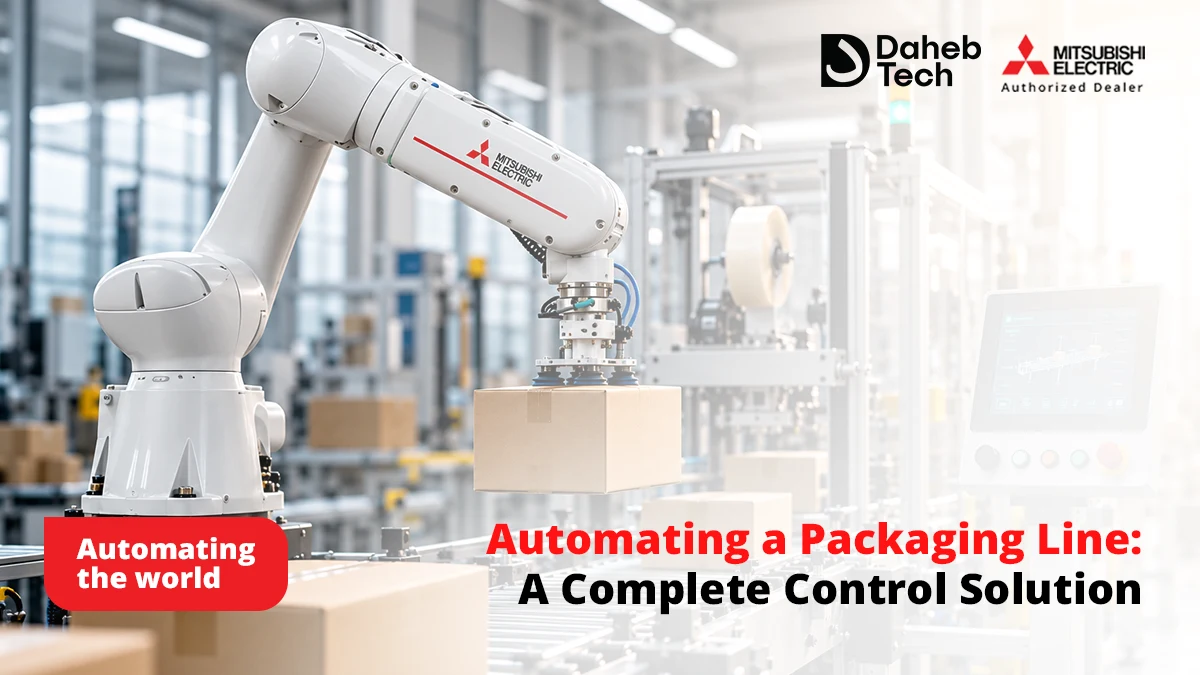
Modern manufacturing operations face mounting pressure to deliver higher throughput, absolute product consistency, and fast changeovers. Traditional packaging lines—often reliant on manual sorting, mechanical linkages, or isolated standalone machinery—frequently become the primary operational bottleneck in a facility. Transitioning to integrated packaging line automation helps plant managers and system integrators overcome these limitations by establishing dynamic, high-speed control across every stage of the packaging cell.
At Daheb Tech, an authorized distributor of Mitsubishi Electric Factory Automation products in the UAE, we engineer unified control systems that transform disconnected machinery into synchronized production networks. Whether operating in Food & Beverages, Pharma, Plastics, Printing, or the Cable Industry, packaging manufacturers in the UAE and wider GCC require reliable architectures to maintain operational resilience. This guide explores how programmable logic controllers, motion controllers, operator interfaces, and articulated robots work together to optimize end-of-line packaging.
1. The Challenge: Operational Bottlenecks in Modern Packaging Lines
Manual and semi-automated packaging equipment introduces operational friction that directly limits overall plant performance. Plant managers and automation engineers frequently encounter several recurring challenges on the factory floor:
- Throughput Bottlenecks: Mechanical indexers and manual loading stations cap processing speeds. When incoming product feed rates fluctuate, legacy machinery often fails to adjust dynamically, resulting in material backing up or physical jamming.
- Quality Inconsistency and Scrap: Inconsistent manual placement often causes misaligned carton seals, damaged goods, and misapplied labels. Relying on manual visual inspection increases human error and elevated scrap rates.
- Slow Packaging Line Changeover: Converting a line between different product variants typically requires manual tool adjustments, chain tensioning, and trial-and-error sensor placement. These manual steps can consume hours of planned production time per shift.
- Labor Shortages and Rising Costs: High turnover rates and physical fatigue among end-of-line workers lead to variable shift output and unpredictable operating overhead.
Industrial surveys highlight these operational realities. According to intelligence reports published by PMMI, The Association for Packaging and Processing Technologies, finding and retaining skilled workforce remains a dominant challenge across manufacturing plants, accelerating the adoption of secondary handling and primary packaging automation. Addressing these challenges requires replacing standalone equipment with an integrated end-of-line packaging automation strategy.
2. Solution Architecture: Unified Components Working as One
Solving complex packaging challenges requires moving away from piecemeal equipment toward a centralized architecture. In a synchronized system, each control component fulfills a dedicated operational function.
|
|
|
|
|
|
|
|
|
|
|
|
|
|
|
|
|
|
|
|
|
|
|
|
|
Need help selecting hardware for your control cabinet? Talk to our application engineers at Daheb Tech for custom component sizing and architectural support in the UAE.
3. How It Works Together: End-to-End Signal and Data Flow
A unified control system relies on deterministic industrial networking to share data rapidly across vision, motion, logic, and robotic subsystems. The technical sequence of an integrated packaging cell operates as follows:
- Product Detection and Vision Acquisition: As unoriented products arrive on the main feed conveyor, a high-speed photo-eye triggers an optical sensor. The vision system calculates the precise X-Y positioning and orientation angle of each item, passing coordinate data to the central controller via industrial Ethernet.
- Motion Tracking and Linear Synchronization: High-resolution optical encoders attached to conveyor drives transmit real-time speed data directly to multi-axis motion modules. The system calculates the exact physical location of moving products along the conveyor belt.
- Robot Target Assignment: The MELSEC PLC controllers process vision coordinates alongside encoder feedback to generate dynamic target vectors for down-line machinery.
- Dynamic Pick-and-Place Execution: A pick and place packaging robot executes vision-guided conveyor tracking. The robot synchronizes its end-effector speed with the moving belt, picking items without stopping the conveyor and placing them into erected cartons.
- Servo-Driven Carton Indexing: MELSERVO drives advance filled cartons to a sealing station. Optical sensors verify carton presence, while pre-configured motion profiles ensure smooth acceleration to protect internal product positioning.
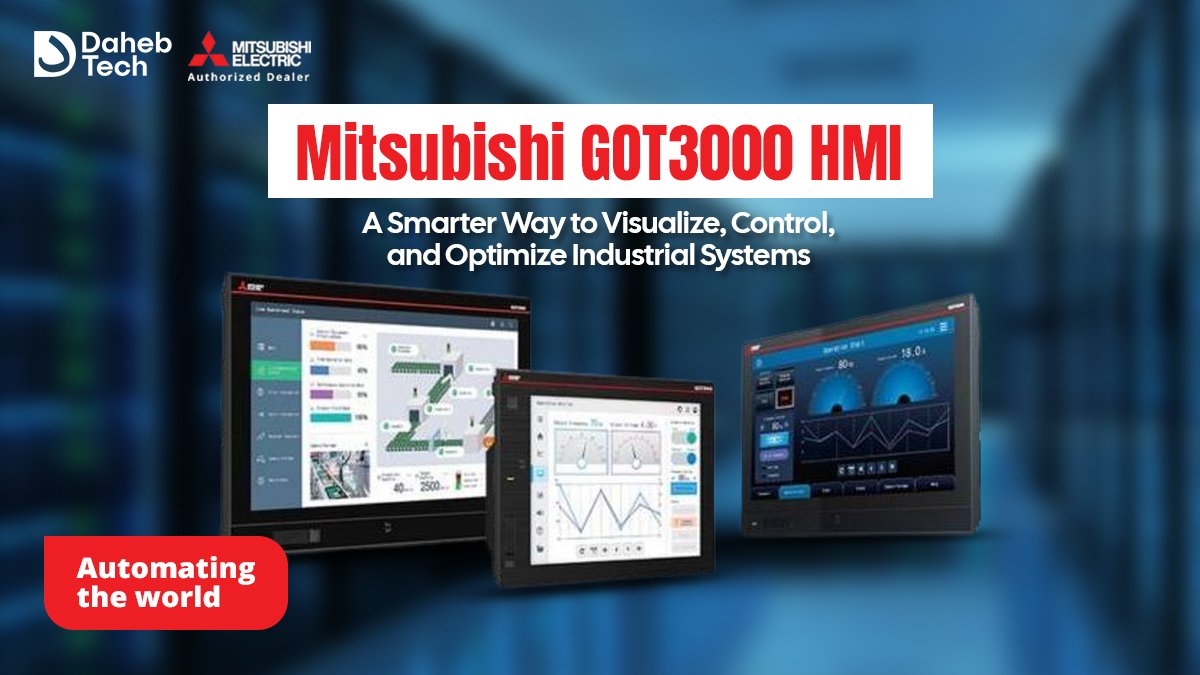
- HMI Data Display and Quality Gate: Downstream vision solutions for inspection verify flap closure and barcode readability. The PLC logs operational metrics and updates KPIs on the GOT HMI terminal. If an anomaly occurs, the HMI displays a targeted diagnostic graphic pointing directly to the fault location.
Example Application (Illustrative Scenario):
Consider an end-of-line case packing cell in a regional food production facility. Primary packaged goods arrive on a continuous conveyor at variable intervals. An overhead camera captures product orientation and transfers data to a compact PLC platform, such as the Mitsubishi FX5. A 6-axis robot tracks the moving belt to load items into shipping cases, while a multi-axis servo system indexes cases through a taping unit. Operators select product profiles on a touchscreen HMI, eliminating mechanical readjustments during product runs.
4. Concrete Business Outcomes
Adopting an integrated control architecture delivers measurable operational gains for industrial manufacturing facilities:
- Increased Overall Throughput: Automated conveyor tracking and robotic pick-and-place enable steady, continuous operation at higher overall line speeds.
- Predictable Labor Overhead: Transitioning repetitive handling tasks to automated systems reduces line staffing dependencies and stabilizes output across multiple working shifts.
- Minimized Product Scrap: Precise servo positioning and gentle robotic handling can eliminate package crushing, misapplied seals, and damaged outer cartons.
- Faster Recipe Changeovers: Selecting pre-programmed parameters on the HMI automatically updates servo stroke lengths, sensor timings, and robot trajectories, significantly reducing changeover duration.
- Reduced Downtime: Integrated diagnostics display active alarms and physical fault locations on screen, helping maintenance teams lower Mean Time to Repair (MTTR).
5. System Scalability: From Standalone Lines to Enterprise Operations
An integrated control architecture scales systematically to match changing production demands. Small facilities can begin by deploying a compact PLC paired with a small HMI and a single pick-and-place robot for basic carton loading.
As production expands, additional servo axes, vision cameras, and a dedicated palletizing robot can be incorporated into the existing network using expansion modules. For enterprise facilities operating multiple production lines, individual packaging cells connect directly to plant-wide Manufacturing Execution Systems (MES) or Edge Computing platforms. For additional details on industrial automation infrastructure, consult our guide on factory automation in the UAE.
6. Frequently Asked Questions
Which Mitsubishi Electric products are used in a packaging line?
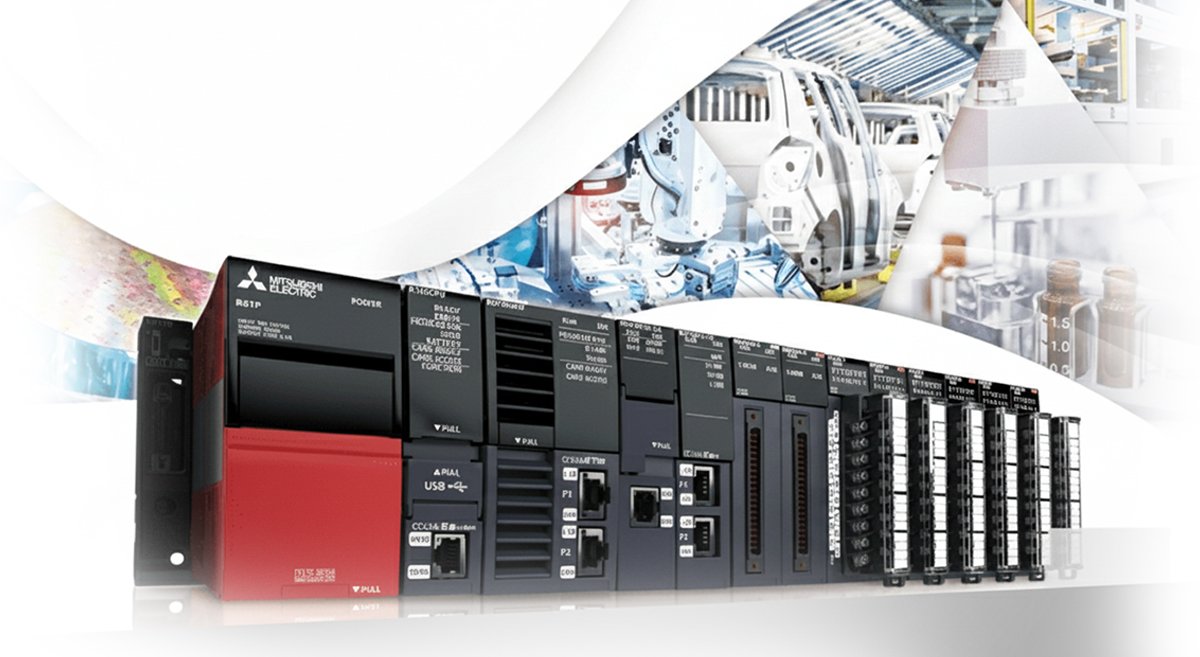
A complete packaging automation solution relies on an integrated family of control products. Logic and machine safety are governed by MELSEC PLC controllers, while dynamic axis positioning is handled by MELSERVO systems. Operators monitor operations and select recipes using GOT HMI operator terminals, and material handling tasks are performed by MELFA industrial robots.
Can this integrated control architecture be retrofitted onto an existing mechanical packaging line?
Yes, legacy mechanical packaging lines can typically be retrofitted with modern control architectures. Engineers often retain structural frames while replacing obsolete line shafts and mechanical cams with servo drives, digital fieldbus networks, and central controllers. Implementation scope depends on mechanical wear and structural layout. For technical evaluations, consult our regional engineering services.
How scalable is the control solution if our product volume doubles next year?
The control architecture is highly scalable due to modular PLCs and expandable fieldbus networks. Additional servo axes, vision sensors, or palletizing cells can usually be added to the existing network without redesigning the core logic. System expansion requires verifying controller memory limits and network bandwidth.
Can the packaging cell run in an unattended or lights-out configuration?
Lights-out operation is achievable depending on the application, but it requires comprehensive risk assessments, automated material feed mechanisms, robust failure handling, and physical safeguarding. Automated cell safety should align with international machinery standards such as ISO 13849-1 for safety-related parts of control systems.
How does the automated system handle product jams or component failures?
The PLC detects jams by monitoring torque feedback and optical sensor interrupts, triggering an immediate controlled sequence to protect equipment. Graphical diagnostic displays on the HMI pinpoint the exact fault location for fast resolution. Safety logic follows recognized machinery safety guidelines, such as ISO 10218-1 for industrial robot safety requirements.
What cybersecurity measures protect connected PLCs and HMIs from external threats?
Industrial automation networks maintain cybersecurity by physically or logically isolating operational technology (OT) from enterprise IT networks. Best practices include network segmentation, restricted port usage, user access management, and secure remote gateways aligned with industrial security frameworks like IEC 62443.
What is the typical expected payback period for a packaging line automation project?
Payback periods vary significantly based on operating hours, throughput demand, current scrap rates, and labor structure. Facilities generally evaluate return on investment by measuring labor flexibility gains, reduced product damage, and increased operational uptime across production cycles.
Elevate Your Packaging Automation Infrastructure
Upgrading your packaging automation infrastructure requires reliable hardware, intelligent architecture, and experienced regional technical support. As an authorized distributor of Mitsubishi Electric Factory Automation devices in the UAE, Daheb Tech supplies the full range of controllers, motion systems, HMIs, and industrial robots needed to optimize modern production facilities.
- Explore our complete hardware lineup across all product categories.
- Ready to evaluate your packaging line layout? Request a quote from our engineering team today.