Mitsubishi CC-Link Slice I/O (NZ2FT Series): Distributed I/O Architecture for High-Performance Automation
Mitsubishi CC-Link Slice I/O (NZ2FT Series): Distributed I/O Architecture for High-Performance Automation
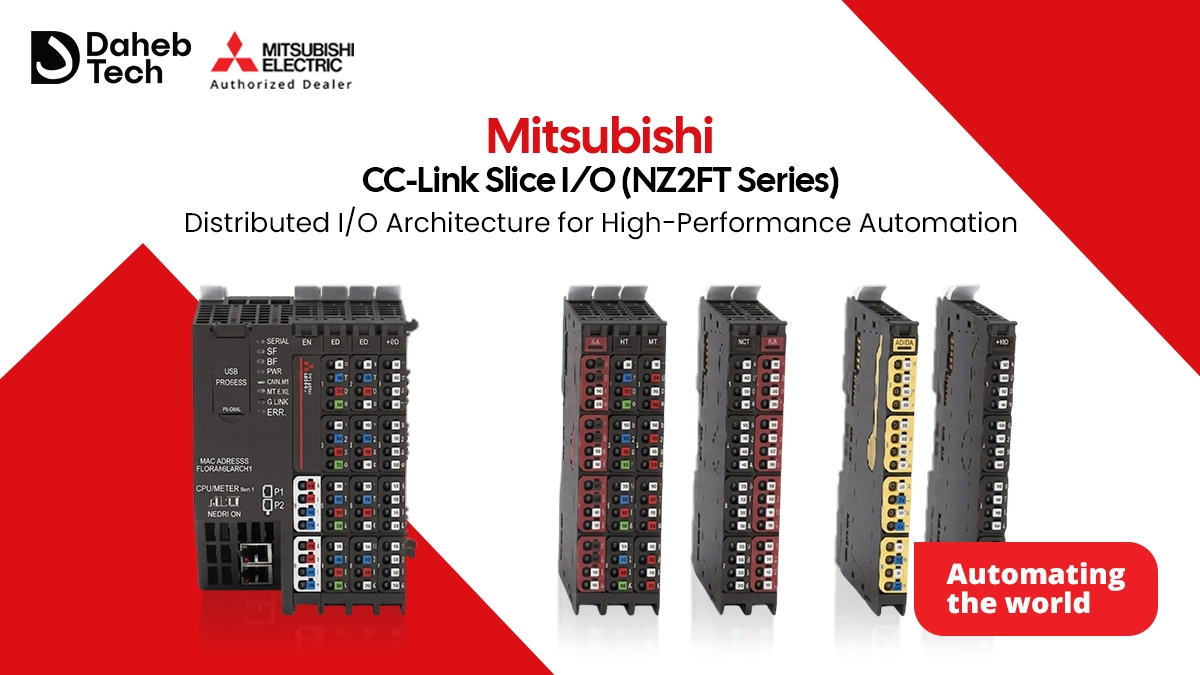
What is Mitsubishi CC-Link Slice I/O?
Mitsubishi CC-Link Slice I/O (NZ2FT series) is a modular distributed remote I/O platform that places input/output modules near field devices and communicates with PLCs over CC-Link IE / CC-Link IE TSN networks.
This architecture reduces wiring, improves signal integrity, and enables deterministic, real-time control across scalable automation systems.
Why Distributed I/O Matters in Modern Plants
Centralized panels increase cable runs, introduce noise, and slow commissioning. Distributed I/O addresses these limitations by:
- Shortening cable paths → lower voltage drop and noise susceptibility
- Reducing installation effort → fewer terminations and routing constraints
- Improving responsiveness → local signal acquisition with deterministic network transfer
Typical impact: up to 60% reduction in wiring complexity and materially faster commissioning on multi-machine lines
Slice I/O Fundamentals and System Composition
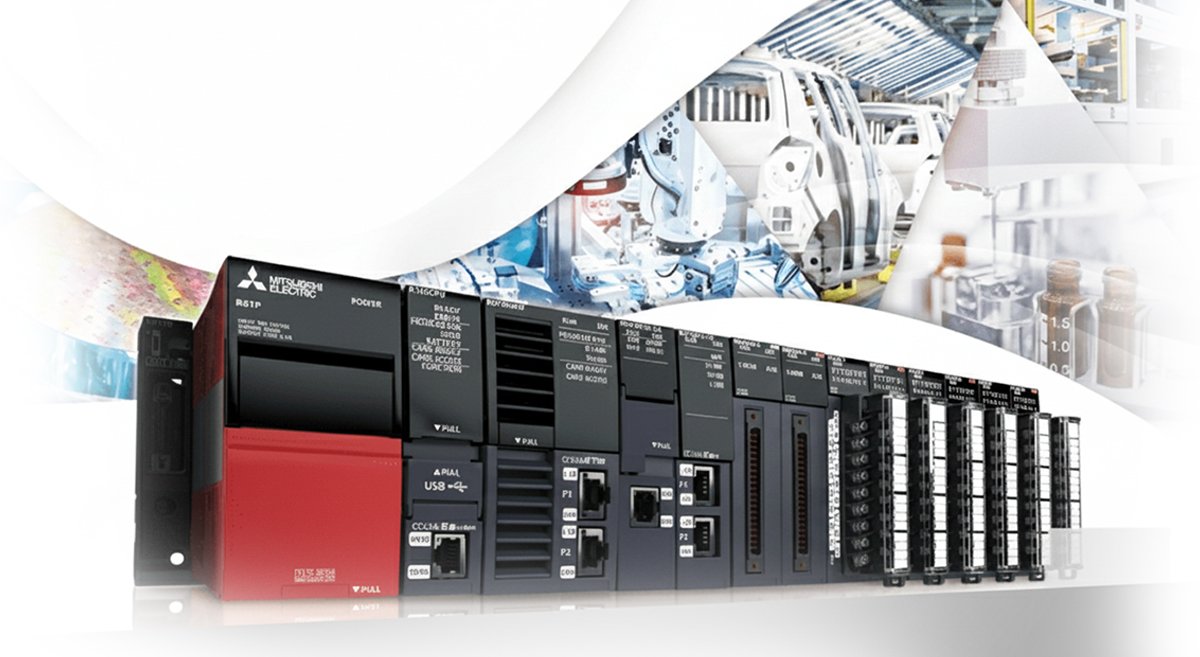
A Slice I/O station is assembled on a DIN rail from function-specific modules:
- Bus/Network Coupler – interfaces the station to CC-Link IE / TSN
- Power Module – distributes field and logic power
- Digital/Analog I/O Modules – acquire and drive signals
- Optional Safety Modules – safety-rated inputs/outputs within the same station
Engineering role: acts as a field-level aggregation layer, converting device signals into networked data for the PLC while keeping signal paths short and clean.
CC-Link IE / TSN Communication Model
Data Flow
- Sensors/actuators generate discrete and analog signals
- NZ2FT modules capture and condition signals locally
- Data is transmitted via CC-Link IE / CC-Link IE TSN
- PLC (MELSEC iQ-R / iQ-F) executes logic and coordination
- Outputs are issued back to field devices
Key property: deterministic cyclic communication with bounded latency.
CC-Link IE TSN additionally allows time-critical control traffic and standard Ethernet data to coexist on a single network without compromising cycle consistency.
Core Capabilities and Engineering Advantages
Modular, High-Density Expansion
- Scales to dozens of modules per station (≈64)
- Supports phased expansion without redesign
Push-In Termination
- Tool-less wiring with consistent contact pressure
- 20–30% faster installation and reduced termination variability
Hot-Swap Maintenance
- Replace modules without stopping the system
- Minimizes production interruption in continuous processes
Integrated Safety (SIL3 / PL e)
- Combines standard and safety I/O in one platform
- Reduces separate safety hardware and panel footprint
Web-Based Diagnostics
- Embedded web server for configuration and monitoring
- Accelerates commissioning and fault isolation
Performance Characteristics and Practical Impact
| Parameter | NZ2FT Slice I/O Capability |
|---|---|
| Communication | CC-Link IE / TSN |
| Data Handling | Deterministic real-time |
| Expansion | High-density modular |
| Maintenance | Hot-swappable modules |
| Safety | SIL3 / PL e compliant |
Observed benefits in deployments:
- Up to 60% less wiring
- 30-50% smaller panels in distributed layouts
- Faster commissioning and reduced MTTR (localized diagnostics)
Application Example: High-Speed Printing and Converting
Requirements
- Tight multi-axis synchronization
- High-frequency sensor feedback (registration, speed)
- Minimal latency and predictable cycles
Implementation
- NZ2FT stations distributed across machine sections
- Deterministic exchange over CC-Link IE TSN
- Central PLC coordinates motion, registration, and outputs
Results
- 20-30% reduction in wiring time
- Improved registration accuracy and throughput stability
- Faster troubleshooting via module-level diagnostics
Typical Deployment Scenarios
- Automotive assembly lines - distributed welding, handling, and inspection
- Oil & gas / utilities - remote I/O across large or hazardous areas
- Conveyors and material handling - scalable motor and sensor networks
- Smart factories (IIoT) - edge data acquisition feeding MES/ERP systems
Centralized vs Distributed (Slice) I/O
| Feature | Centralized I/O | Slice I/O (NZ2FT) |
|---|---|---|
| Architecture | Centralized | Distributed |
| Wiring | Complex | Simplified |
| Scalability | Limited | High |
| Maintenance | Time-intensive | Fast & localized |
| Downtime Risk | High | Minimal |
Frequently Asked Questions
What is CC-Link Slice I/O?
A modular distributed I/O system that connects field devices to PLCs over CC-Link networks for real-time control.
How does it reduce downtime?
Through hot-swappable modules and localized diagnostics, allowing maintenance without halting the entire line.
CC-Link vs Ethernet/IP what’s different?
CC-Link IE TSN delivers deterministic real-time cycles natively, while Ethernet/IP typically requires additional configuration for comparable determinism.
Is it suitable for Industry 4.0?
Yes TSN enables convergence of control and IT data on one network, supporting analytics and system integration.
Which PLCs are supported?
Mitsubishi MELSEC iQ-R and iQ-F series.
Implementation and Procurement Considerations
- Validate network topology (line/ring) and required cycle times
- Size stations based on I/O count and update rates
- Plan power segmentation (field vs logic) and protection
- Define safety architecture (SIL/PL requirements) early
- Standardize on diagnostics and naming conventions for faster commissioning
Conclusion
Mitsubishi CC-Link Slice I/O (NZ2FT series) provides a scalable, deterministic, and serviceable foundation for distributed automation. By relocating I/O to the field and leveraging CC-Link IE / TSN, it reduces installation effort, improves uptime, and supports future expansion.
DahebTech is an authorized dealer of Mitsubishi Electric in the UAE, supplying genuine components along with application engineering and after-sales support for industrial automation projects. Partnering with an authorized source ensures product authenticity, proper system design guidance, and dependable lifecycle support.