

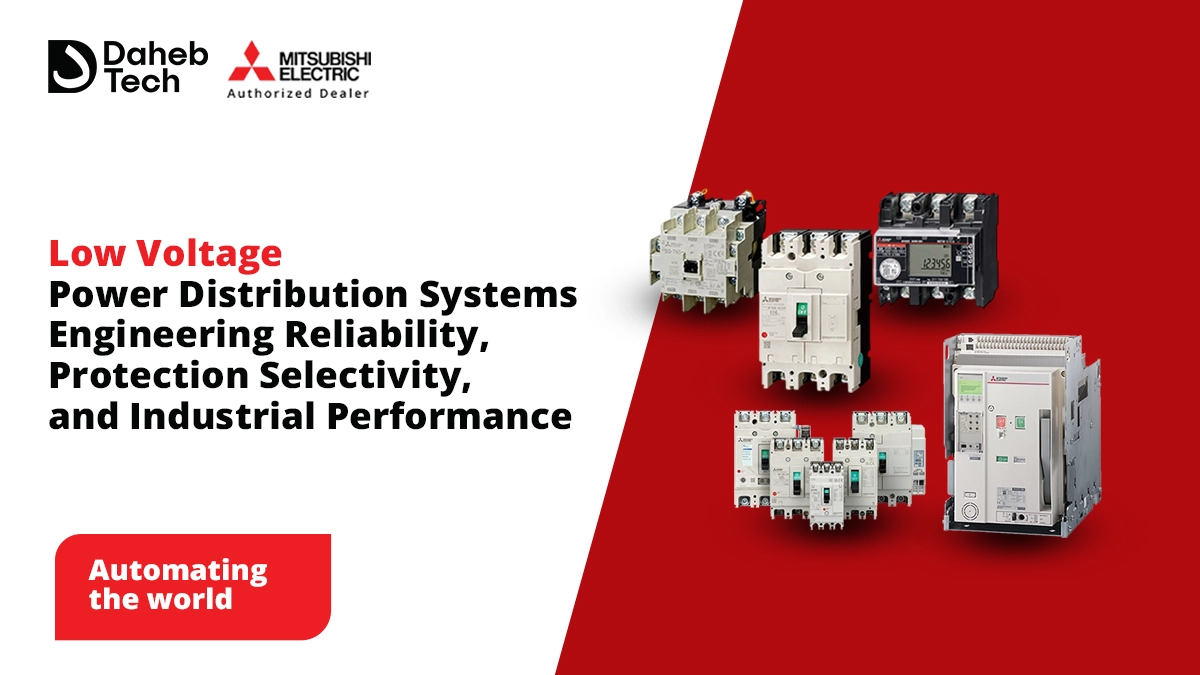
In industrial environments, electrical failures rarely originate at the load they originate within the low voltage power distribution system. Inadequate protection coordination, improper device selection, or poor load structuring often leads to system-wide outages instead of localized fault isolation.
This is why modern LV systems are no longer passive infrastructure. They operate as engineered control layers, directly influencing uptime, safety, and long-term operational efficiency.
Low voltage systems (≤1000V) represent the final stage of power delivery, but in engineered facilities, they function as segmented and actively protected electrical networks.
A properly designed system ensures:
In high-load industrial panels, failure to maintain control at this layer results in cascading faults that propagate faster than protection devices can respond.
Protection coordination defines whether a system behaves predictably under fault conditions.
In poorly designed systems:
This is commonly observed in retrofit installations, where existing breaker curves are not aligned with updated load profiles.
Effective LV design follows selectivity principles, ensuring that:
In high fault-current environments (>50kA), incorrect breaker selection often results in failure to interrupt or delayed tripping, increasing system risk. In such systems, arc fault energy and short-circuit levels must be carefully evaluated, as uncontrolled arc conditions can escalate into severe equipment damage and safety hazards if protection devices are not properly rated.
Component selection must be based on system behavior not catalog specifications.
In high-capacity systems, underspecified MCCBs often fail to provide adequate breaking capacity, leading to thermal stress and potential equipment damage.
Selecting the right combination of protection devices is not optional it defines system reliability. For engineers evaluating configurations and component combinations, reviewing industrial low voltage power distribution products
provides a clearer understanding of how protection devices align with real operating conditions.
Industrial power systems operate across mixed load profiles:
Without proper segmentation:
Segmented distribution ensures priority-based operation and fault containment, improving system resilience.
Thermal performance is often underestimated in LV panel design.
In compact panels, busbar overheating is frequently caused by incorrect current density calculations rather than actual overload conditions.
Key considerations include:
Over time, unmanaged thermal stress leads to insulation breakdown, reduced component lifespan, and unpredictable failures.
Industrial LV systems must comply with internationally recognized standards to ensure safety and performance consistency:
Compliance ensures:
Ignoring these standards results in systems that may function initially but fail under stress conditions or peak demand scenarios.
Low voltage distribution is tightly coupled with:
In automation-heavy environments, LV systems act as the stability backbone for motion and control layers.
For a broader system-level perspective, refer to industrial drive and automation solutions
Modern LV systems are evolving into data-enabled electrical networks.
With integrated monitoring capabilities:
This transforms power distribution into a strategic operational asset rather than a static utility layer.
The impact of LV system design decisions is measurable:
In commissioning environments, improper protection coordination is often only identified during live load testing—when unexpected upstream tripping reveals underlying system design gaps.
In industrial systems, reliability is often evaluated at the equipment level but it is fundamentally determined at the power distribution layer. Well-designed low voltage power distribution systems ensure stability, protection accuracy, and long-term operational efficiency across complex industrial environments.
Daheb Tech Electrical Devices Trading LLC, an authorized dealer of Mitsubishi Electric, delivers engineered low voltage distribution solutions aligned with real-world industrial requirements.
With access to genuine and certified Mitsubishi Electric components, combined with application-specific engineering support, DahebTech enables both new installations and system upgrades ensuring electrical infrastructures are not only compliant, but optimized for performance, protection, and scalability.